
Game Theory Trading: How to Think Like an Institution
What if trading isn’t about finding the perfect indicator, but about understanding who you’re playing against? That’s the core idea behind game theory trading, and once you see the market through this lens, you can’t unsee it.
Most retail traders spend years tweaking chart setups without ever asking a simple question: who is on the other side of my trade? Game theory answers that question by treating the market as a strategic game, one where every participant has different incentives, different resources, and a very different playbook.
In this guide, you’ll learn how to identify the key players in any market, understand why price moves the way it does – and, most importantly, stop being the predictable trader that institutions love to exploit.
What Is Game Theory in Trading?
Game theory is a decision-making framework that studies how participants interact competitively. Originally developed for economics and military strategy, it applies beautifully to financial markets because trading is, at its core, a competitive game with money as the reward.
When you apply game theory to trading, you stop thinking of your chart as an isolated puzzle. Instead, you start seeing it as a multi-player strategic environment where your decisions depend on, and are affected by, the decisions of every other participant.
This mental shift is powerful. Instead of asking “Where will price go?” you start asking “What does the other player need price to do?” That single reframe can transform your results.
Know Your Opponents: The Four Key Market Players
In game theory, you can’t play well unless you know who’s at the table. Here are the four main participants you’re sharing the market with, each operating with a completely different set of incentives.
1. Liquidity Providers (Market Makers)
These are the entities that create the marketplace itself. Think of them as the house in a casino, they’re not betting on direction. Their goal is to manage inventory risk and keep order flow moving. They earn money through spreads and commissions regardless of whether price goes up or down.
The key insight: market makers don’t want to hold positions longer than necessary. They’re always looking to offset risk by passing inventory on to willing buyers and sellers.
2. Institutional Traders
This is where the “smart money” lives. Institutions have enormous capital, sometimes hundreds of millions of dollars, that they need to deploy. Here’s their problem: they can’t just place a massive buy order without moving the market against themselves.
So what do they do? They hunt for liquidity. They need pools of opposing orders to fill their positions without causing excessive slippage. This single fact explains a huge amount of “unexplainable” price action.
💡 Key Takeaway: Institutions often drive price against their intended direction to trigger stop losses, which releases liquidity they then use to fill their real orders.
3. Retail Traders (That’s You)
Retail traders are looking for directional opportunities, places to buy and sell for profit. The challenge is that most retail behavior is highly predictable. Breakout entries, obvious stop placements, and herd-like patterns make retail traders a reliable source of liquidity for institutions.
4. Algorithmic Traders
Algo traders are constantly entering and exiting positions at high speed. While they’re often seen as disruptive, they actually serve an important function: they inject liquidity into the market. This continuous participation helps tighten spreads and makes execution conditions better for everyone.
How Liquidity Drives Everything in the Market
If game theory trading has one foundational principle, it’s this: price moves toward liquidity. Understanding where liquidity accumulates, and why, is the single most important edge you can develop.
Where Liquidity Clusters
Liquidity (which is just money sitting in the market as pending orders) tends to pool in predictable locations:
- Below obvious swing lows, where traders cluster their stop-loss orders
- Above obvious swing highs, where breakout buy-stops and take-profit orders sit
- Around key structural levels like support, resistance, and supply/demand zones
- At session boundaries, the highs and lows of previous trading sessions (Asian, European, North American)
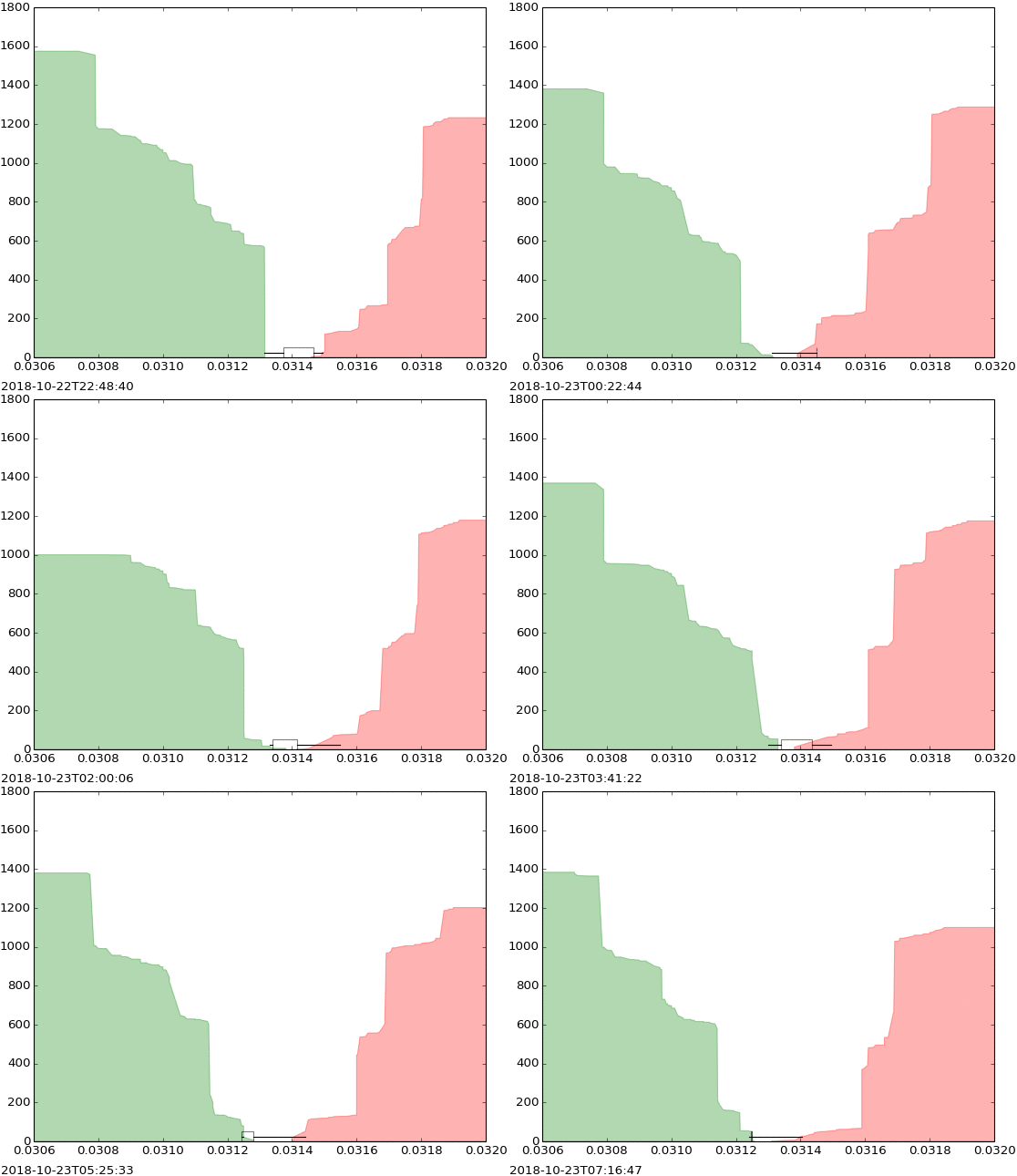
Here’s the critical mental model: an order book typically shows thin liquidity near the current price and thicker liquidity at the extremes. Price can move easily in the thin zone but tends to bounce once it hits those deeper pools at swing highs and lows. Here is an image illustrating this:
💡 Remember the phrase: “Volatility is a function of available liquidity.” Low liquidity environments (like small-cap crypto) produce wild, unpredictable swings. High liquidity environments (like EUR/USD) produce smoother, more readable price action.
Liquid vs. Illiquid Markets
Not all markets behave the same way. Highly liquid markets, major currency pairs, gold, major equity indices, have deep order books and relatively predictable structure. Illiquid markets, rare collectibles, small-cap crypto, art, have thin order books where a single large order can move price dramatically.
When applying game theory to your trading, always consider the liquidity context. The same pattern might signal a reliable setup in EUR/USD but a trap in a thinly traded altcoin.
Stop Hunt Mechanics: The Game Theory Pattern You Need to Know
This is where game theory trading gets really practical. If you’ve ever been stopped out of a perfectly good trade only to watch price reverse and run in your original direction, you’ve experienced a stop hunt, and it’s not random.
How a Stop Hunt Works, Step by Step
- Price approaches a key demand or supply zone, and retail traders enter positions at obvious levels.
- Institutions identify the cluster of stop-loss orders sitting just below the zone (this is predictable retail behavior).
- Institutions use a portion of their capital to push price through the zone, triggering those stops.
- The triggered stops release liquidity into the market, sell orders from long positions being closed out.
- Institutions scoop up this liquidity to fill their large buy orders at discounted prices.
- Price reverses sharply in the direction the institution intended all along.
This pattern plays out across all timeframes and all asset classes. It’s the reason that price often “pokes” below a demand zone before reversing strongly, the poke is the institutions loading their position.
The Range Fake-Out
A closely related pattern happens around trading ranges. When price breaks above a well-defined range, breakout traders pile in with long positions and place their stops just below the range. Institutions know this.
So price sweeps above the range, collects the breakout buy orders, then reverses back inside. The resulting cascade of stopped-out longs provides fuel for the institutions’ intended directional move, often downward.
💡 When price breaks out of a range and then snaps back inside, treat it as information, not as a failed trade. Game theory says this is the institution revealing its hand.
How to Stop Being the Predictable Trader
If institutions exploit predictable behavior, the solution is straightforward: become unpredictable. Here are actionable ways to do that.
Rethink Your Stop Placement
Most traders place stops at “obvious” levels, just below a swing low, just above a swing high. Institutions know exactly where these clusters are. Instead, consider placing your stop significantly further away, below the entire zone rather than at its edge.
Yes, this means a wider stop. But a wider stop that doesn’t get hunted is infinitely better than a tight stop that gets picked off before your trade even has a chance to work.
Use Multiple Entry Points
Instead of committing your entire position at one price, split it into pieces:
- Enter a portion at the buy zone (aggressive entry)
- Enter another portion at the edge of the demand area
- Reserve a final portion for the sweep below the zone, the stop hunt itself
If the first two entries get stopped out but the third catches the sweep, the risk-reward ratio on that third entry is often so favorable that it covers the losses and then some. This is mixed strategy thinking in action, straight from game theory.
Vary Your Behavior
Don’t use the same entry method, the same stop distance, or the same risk profile on every trade. Mechanical, repetitive behavior is exactly what makes retail traders exploitable. Mix it up, not randomly, but strategically, based on what you observe about liquidity conditions in the current setup.
Reading Market Regimes Through a Game Theory Lens
Markets alternate between two primary regimes, and recognizing which one you’re in changes everything about how you apply game theory.
Range (Mean Reversion) Regime
In ranging conditions, price oscillates between highs and lows. Stop hunts are frequent, price pokes above the range to collect sell stops, then reverses back inside. It pokes below to collect buy stops, then bounces. This is classic mean-reversion behavior, and breakout strategies get destroyed here.
Expansion (Momentum) Regime
Expansion happens when price hits significant time-based or price-based liquidity on a higher timeframe, weekly demand, for example, and reverses decisively. In this regime, breakouts do follow through, but only because the institutional loading pattern (the stop hunt into the zone) has already been completed. The fuel is loaded; now the move can extend.
The key difference: in a range regime, the sweep is the move. In an expansion regime, the sweep is the setup for a much larger move.
Common Game Theory Trading Mistakes to Avoid
- Treating every breakout as genuine without checking whether liquidity has been swept first
- Placing stops at the most obvious structural level instead of giving yourself room
- Ignoring session context, Asian session ranges are often liquidity targets for the European open
- Forgetting that institutions need time to fill orders, the loading pattern takes multiple swings
- Trading against the higher-timeframe flow because you’re focused only on lower-timeframe structure
Frequently Asked Questions
Does game theory work in all markets?
Yes, the core principles apply wherever there are competing participants with different incentives. However, the mechanics are most visible in markets with moderate-to-high liquidity, such as forex majors, gold, and equity indices. In extremely illiquid markets, price action can be too erratic for clean game theory patterns.
Do I need to abandon my current strategy?
Not necessarily. Game theory is a lens, not a standalone strategy. It’s most powerful when layered on top of your existing approach, helping you filter setups, improve stop placement, and understand the “why” behind price moves you’re already trading.
How do I identify institutional activity on a chart?
Look for the signature patterns: price sweeping beyond an obvious level and then quickly reversing, large candle wicks into key zones, and price behavior that seems designed to trigger stops before moving in the opposite direction. With practice, these footprints become increasingly visible.
Conclusion
Game theory trading isn’t about memorizing patterns, it’s about changing how you think. Every time you place a trade, you’re sitting at a table with market makers, institutions, algorithms, and thousands of other retail traders. The question isn’t whether the game is being played. The question is whether you know the rules.
Three things to take away from this guide:
- Price moves toward liquidity. Always ask where the clusters of orders are before entering a trade.
- Institutions exploit predictable behavior. Your job is to stop being the predictable player at the table.
- Stop hunts aren’t random. They’re the mechanism by which large players fill their orders, and once you see this, you can plan around it.
Start applying game theory to your next trading session. Before you click buy or sell, pause and ask: Who is on the other side of this trade, and what do they need price to do? That single question will sharpen your decision-making more than any indicator ever could.
Editor’s Note
- Smart Money Playbook: https://pipnotic.org/courses/smart-money-playbook-mastering-supply-and-demand/
- S/D zone identification guide: https://pipnotic.org/7-essential-supply-and-demand-trading-patterns-for-beginners/
- Order book diagram showing thin liquidity at spot and thick liquidity at extremes: https://en.wikipedia.org/wiki/Order_book
- Stop hunting: https://www.investopedia.com/terms/s/stophunting.asp