
There’s a moment every trader experiences, usually around 3 AM, face illuminated by the blue glow of Bloomberg terminals, double-espresso number four wearing off, when they think:
There has to be a better way.
Well, buckle up, because we’re about to dissect a single command that’s basically the trading equivalent of hiring a tireless, emotionless, caffeinated analyst who never sleeps, never panics, and delivers actionable FX intelligence to your Discord channel every single morning at precisely 7:00 AM Singapore time, which I use to take trades like this one. This is the exact prompt that I use to help me turn economic data and central bank policies into easily understandable action points.
Welcome to the future. It’s automated, it’s beautiful, and it fits in one terminal command.
The Command That Never Sleeps
openclaw cron add \
  --name "Daily G8 FX actionable research" \
  --cron "0 7 * * *" \
  --timeout 120000 \
  --tz "Asia/Singapore" \
  --session isolated \
  --announce \
  --channel discord \
  --to "xxxxxxxxxxx" \
  --message "Build a Daily Actionable FX Trade Plan covering: EUR,USD,GBP,CAD,NZD,AUD,CHF,JPY

Identify the most important developments affecting:
- Federal Reserve (USD)
- ECB (EUR)
- Bank of England (GBP)
- Bank of Japan (JPY)
- Swiss National Bank (CHF)
- Bank of Canada (CAD)
- Reserve Bank of Australia (AUD)
- Reserve Bank of New Zealand (NZD)

Include only:
- Central bank updates
- CPI, GDP, employment, PMI, retail sales
- Bond yield moves
- Rate expectations
- Major geopolitical drivers
- Overall risk sentiment (risk-on / risk-off)

Prefer:
- Central banks
- Official statistics offices
- Major financial news sources

If a source fails:
- Replace it
- Continue
- Always produce a full report

1) Executive Summary (Max 5 bullets)
- What is driving FX today
- Risk sentiment
- Yield / policy divergence theme

2) What To Trade Today
- Currencies to BUY and why
- Currencies to SELL and why
- Strongest relative pairs (e.g., Long USD/JPY)
- Clear invalidation conditions (what would prove this wrong)

3) What To Monitor (Next 24–72h)
List only high-impact upcoming events.

Rules:

- Clearly separate facts from analysis.
- Focus only on what to trade and why.
- No fluff.
- Keep under 400 words.
- Always deliver a report even if some sources fail."
All cron jobs, this one included will now be added to the OpenClaw configuration and made ready to execute. Here is a sccreen-shot ot the crons:
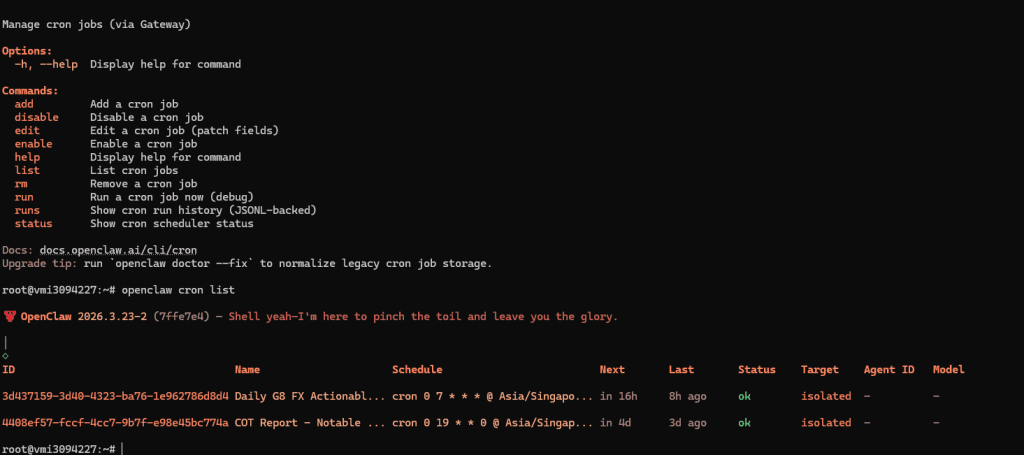
Let’s unpack this monster, argument by argument, because every piece here is doing something quietly brilliant.
openclaw cron add: The Foundation
OpenClaw is your autonomous AI agent framework, think of it as a robot assistant that can actually do things instead of just chatting. The cron add subcommand tells OpenClaw:
I want you to run something on a schedule, repeatedly, forever, until the heat death of the universe or I tell you to stop.
This isn’t a reminder. This isn’t a calendar notification. This is task automation where the task involves synthesizing global macroeconomic data, central bank policy positions, and geopolitical developments into a coherent trading strategy.
Every. Single. Day.l
--name "Daily G8 FX actionable research": Give Your Robot a Name
This is metadata your human-readable label for this particular automated OpenClaw cron job. When you’re managing dozens of cron jobs (and trust me, you will be), you’ll want descriptive names.
“Daily G8 FX actionable research” tells you exactly what this does. Not “Morning Job #4” or “thingy_v2”. Professionalism, people.
--cron "0 7 * * *": The Time Machine
Here’s where it gets spicy. This is cron syntax—the Unix scheduling format that’s been running the internet since before most of your portfolios existed.
Let’s decode "0 7 * * *":
- 0 = Minute (0th minute = on the hour)
- 7 = Hour (7 AM in 24-hour format)
- * (first asterisk) = Day of month (every day)
- * (second asterisk) = Month (every month)
- * (third asterisk) = Day of week (every day of the week)
Translation: “Run this at exactly 7:00 AM, every single day, no matter what.”
Not 7:01. Not 6:59. 7:00:00 AM. Precision matters when you’re front-running the London open.
This schedule means your OpenClaw AI analyst is already awake, caffeinated, and delivering research before you’ve even silenced your alarm. While human analysts are still brewing coffee and checking Twitter, your robot has already:
- Scraped the Fed, ECB, BOE, BOJ, SNB, BOC, RBA, and RBNZ
- Analyzed overnight bond yield movements
- Assessed geopolitical developments
- Identified which currency pairs to long and short
- Delivered a sub-400-word executive brief
And it does this every day. Weekends? Sure. Holidays? You bet. Market crashes? Especially then.
--timeout 120000: Don’t Let It Run Forever
120000 milliseconds = 120 seconds = 2 minutes.
This is your kill switch. If the OpenClaw AI agent hasn’t finished compiling the report within 2 minutes, OpenClaw terminates the job. Why?
- Resource management: You don’t want a runaway process eating CPU forever
- Timeliness: If it takes 20 minutes to generate a report for 7 AM, it’s already useless by the time it arrives
- Failure detection: If the job is hanging, something’s wrong, kill it and try again tomorrow
Two minutes is generous for an OpenClaw AI that can parallel-process web scraping, data synthesis, and report generation. This is basically saying: “You have two minutes to save the world. Go.”
--tz "Asia/Singapore": Time Zones Are Not Optional
Asia/Singapore is UTC+8, and this parameter ensures your 7 AM is Singapore’s 7 AM, not UTC 7 AM (which would be 3 PM Singapore time, completely useless for Asia FX traders).
This matters because:
- Tokyo opens at 9 AM JST (8 AM Singapore time)
- Singapore/Hong Kong markets are active from 9 AM local
- You want this research before the cash session begins
Delivering FX research at 7 AM Singapore time means you’re positioned before the Asia-Pacific rush, ready to trade the Tokyo open, and early enough to adjust for London pre-market moves.
Timezone-aware scheduling is the difference between “useful intelligence” and “spam.”
--session isolated: Trust No One, Not Even Yourself
This flag tells OpenClaw to run the job in an isolated session,meaning each execution is a clean slate with no memory of previous runs.
Why isolate?
- No context bleed: Yesterday’s EUR/USD analysis doesn’t contaminate today’s
- Stateless reliability: If one day’s job crashes or hallucinates, tomorrow starts fresh
- Reproducibility: Each run uses the same instructions, same sources, same logic
This is the OpenClaw AI equivalent of “clear your browser cache and try again” – but automated. Every morning at 7 AM, your AI wakes up, forgets everything, and starts from scratch with fresh data.
No biases. No stale opinions. Just cold, hard, current market reality.
--announce: Make Some Noise
This flag enables announcements, meaning OpenClaw doesn’t just run silently in the background. It actively broadcasts that the job has been scheduled, started, completed, or failed.
This is operational transparency. You’ll get notifications like:
- ✅ “Daily G8 FX research job started”
- ✅ “Report delivered to Discord”
- ❌ “Job failed: timeout exceeded”
You’re not flying blind. You know your robot showed up for work.
--channel discord --to "xxxxxxxxxxx": Deliver to the War Room
Instead of emailing you a PDF (which you’ll ignore), or dumping output into a log file (which you’ll never read), this sends the research directly to a Discord channel.
--channel discord= Use Discord as the delivery mechanism--to "xxxxxxxxxxx"= The specific Discord webhook or channel ID
Why Discord?
- Mobile-first: You get a push notification on your phone
- Collaborative: Your whole trading team sees it simultaneously
- Persistent: Searchable history of every daily report
- Real-time: No email delays, no spam filters
The trading floor is now a Discord server, and your AI is the analyst who never stops typing.
--message: The Actual Prompt – A Masterclass in Instruction Design
Now we get to the payload – the actual instructions the AI receives every morning. This isn’t just a message; it’s a carefully engineered prompt designed to produce consistent, actionable, high-quality FX research.
Let’s break it down section by section.
Scope Definition: “Build a Daily Actionable FX Trade Plan covering: EUR, USD, GBP, CAD, NZD, AUD, CHF, JPY”
Notice what’s included: the G8 currencies. These are the most liquid, most traded, most important FX pairs in the world. This isn’t some exotic emerging market play, this is the core of global FX markets.
By explicitly listing the currencies, you eliminate ambiguity. The OpenClaw AI isn’t going to waste time analyzing Turkish Lira or South African Rand unless you tell it to.
Central Bank Monitoring: “Identify the most important developments affecting…”
The prompt lists eight central banks:
- Federal Reserve (USD) – The world’s most powerful central bank
- ECB (EUR) – Eurozone monetary policy
- Bank of England (GBP) – UK interest rates and inflation
- Bank of Japan (JPY) – Yield curve control, negative rates
- Swiss National Bank (CHF) – The safe-haven central bank
- Bank of Canada (CAD) – Commodity-linked policy
- Reserve Bank of Australia (AUD) – China-sensitive monetary policy
- Reserve Bank of New Zealand (NZD) – Early rate mover
This is fundamental FX analysis 101. Exchange rates are driven by interest rate differentials, and interest rates are set by central banks. By forcing the AI to monitor all eight, you’re ensuring the report captures the relative policy stance across the G8.
Data Prioritization: “Include only…”
The prompt explicitly whitelists what to include:
- Central bank updates (rate decisions, minutes, speeches)
- CPI, GDP, employment, PMI, retail sales (the big macro indicators)
- Bond yield moves (real-time market expectations)
- Rate expectations (forward curves, futures)
- Major geopolitical drivers (wars, elections, tariffs)
- Overall risk sentiment (risk-on vs. risk-off)
This is a filter. The OpenClaw AI could include earnings reports, stock market moves, crypto prices, weather forecasts, but the prompt says: “Only this stuff. Nothing else.”
This keeps the report tight, relevant, and tradeable.
Source Hierarchy: “Prefer: Central banks, official statistics offices, major financial news sources”
This is source quality control. The OpenClaw AI is told:
- Go to the source (Fed.gov, ECB.europa.eu, BLS.gov)
- Trust official data (government statistics, not blog posts)
- Use reputable news (Bloomberg, Reuters, not ZeroHedge comments)
This is how you avoid garbage-in-garbage-out. The AI isn’t scraping random Twitter threads or sketchy Substack newsletters, it’s going to authoritative sources.
Resilience Clause: “If a source fails: Replace it, Continue, Always produce a full report”
This is anti-fragile design.
Websites go down. APIs break. PDFs don’t load. Central bank sites crash during major announcements.
The prompt says: “If you can’t get data from the Fed, go to Bloomberg. If Bloomberg is down, go to Reuters. If everything’s on fire, use cached data. But NO MATTER WHAT, deliver a report.”
This is the difference between “90% uptime” and “100% uptime.” The job never fails to deliver.
Report Structure: Executive Summary, What to Trade, What to Monitor
The prompt enforces a three-section structure:
1) Executive Summary (Max 5 bullets)
- What is driving FX today
- Risk sentiment (risk-on / risk-off)
- Yield / policy divergence theme
This is the TL;DR. In 5 bullets or less, a trader should understand:
- Is the dollar strong or weak?
- Are we in risk-on or risk-off mode?
- What’s the dominant theme (Fed hawkishness, China fears, geopolitical shock)?
Max 5 bullets means no fluff, no filler. Every bullet must earn its place.
2) What To Trade Today
This is the money section. The AI must deliver:
- Currencies to BUY and why
- Currencies to SELL and why
- Strongest relative pairs (e.g., “Long USD/JPY”)
- Clear invalidation conditions (e.g., “If CPI comes in below 3%, exit immediately”)
This isn’t academic analysis. This is actionable intelligence. The OpenClaw AI is saying:
“Buy USD against JPY because Fed is hawkish, BOJ is dovish, and yields are diverging. If US CPI disappoints tomorrow, close the position.”
That last part, invalidation conditions, is brilliant. Every trade needs a stop-loss, and this prompt forces the OpenClaw AI to define what would prove this thesis wrong.
3) What To Monitor (Next 24–72h)
This is the forward-looking section. What events are coming that could move markets?
- Fed speeches?
- Eurozone CPI?
- BOJ meeting?
- NFP on Friday?
This isn’t a full economic calendar dump. The prompt says: “List only high-impact upcoming events.”
This helps traders prepare rather than react. You know what’s coming, so you can position accordingly.
Rules: The Editorial Guidelines
Finally, the OpenClaw prompt lays down non-negotiable rules:
- “Clearly separate facts from analysis” – Don’t mix “CPI was 3.2%” with “I think inflation is cooling”
- “Focus only on what to trade and why” – No macroeconomic philosophy essays
- “No fluff” – Every sentence must add value
- “Keep under 400 words” – Brevity is respect for the reader’s time
- “Always deliver a report even if some sources fail” – Non-negotiable uptime
These rules ensure the output is consistent, concise, and professional. Every morning, you get the same format, the same structure, the same quality.
What This Command Actually Does
Let’s put it all together.
Every day at 7:00 AM Singapore time, this happens:
- OpenClaw wakes up and spawns an isolated AI session
- The AI reads the prompt (the entire
--messageblock) - It scrapes central bank websites, government data sources, and financial news
- It synthesizes CPI, GDP, employment, PMI, bond yields, and geopolitical developments
- It identifies which currencies are strong, which are weak, and why
- It generates trade ideas (Long USD/JPY, Short EUR/GBP, etc.)
- It defines invalidation conditions (what would break the thesis)
- It lists upcoming high-impact events (next 24–72 hours)
- It formats everything into a sub-400-word report
- It posts the report to Discord (your specified channel)
- OpenClaw announces success (or failure, if something broke)
- The AI session terminates (no memory carried forward)
And then, 24 hours later, it does it all again.
Why This Is Mind-Blowing
Let’s be clear about what we just witnessed:
- Automated research: A human analyst would take 1–2 hours to compile this
- Daily consistency: Never misses a day, never takes a vacation
- Sub-2-minute execution: Faster than you can read the morning headlines
- Multi-source synthesis: Pulls data from 8 central banks + macro sources
- Actionable output: Not just data, specific trades with invalidation levels
- Zero marginal cost: After setup, this runs forever for free
You’ve essentially hired a senior FX strategist who:
- Works 365 days a year
- Never gets sick
- Never has a bad day
- Delivers reports in under 2 minutes
- Costs nothing after the initial setup
And it’s all triggered by one command.
The Bigger Picture: The Death of Manual Research?
This isn’t just a cool cron job. This is a glimpse into the future of financial analysis.
Imagine scaling this:
- 10 OpenClaw cron jobs covering different asset classes (FX, equities, commodities, crypto)
- Regional variants (US session, Europe session, Asia session)
- Strategy-specific briefs (momentum, carry, mean-reversion)
- Risk-adjusted portfolio rebalancing (daily, weekly, monthly)
You could build an entire hedge fund research infrastructure using nothing but OpenClaw cron jobs and AI agents.
No junior analysts. No research assistants. No Bloomberg terminal subscriptions.
Just OpenClaw, LLMs, agents, APIs, and Discord channels.
The Only Question That Matters
If you’re a trader, portfolio manager, or financial analyst, the question isn’t “Should I automate my research?”
The question is: “Why haven’t I already?”
Because somewhere out there, someone just set up this exact cron job.
And they’re already two minutes ahead of you.
Every. Single. Day.
Now go schedule your robot army. The markets don’t wait.