
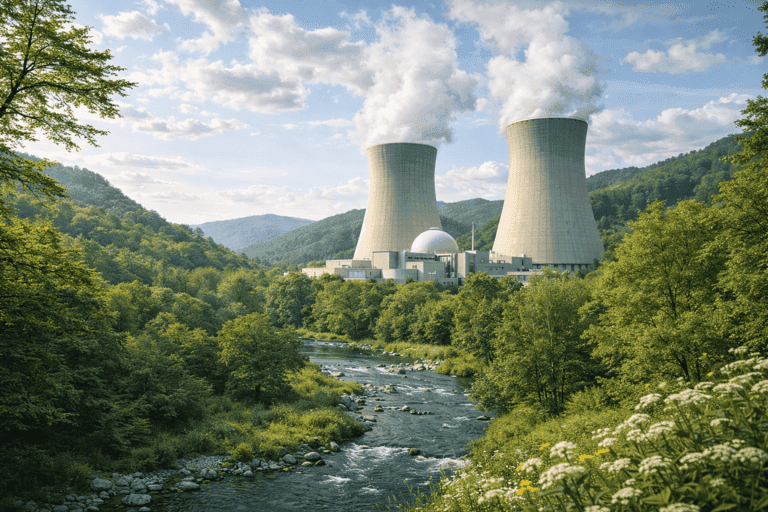
After more than a decade relegated to the “wilderness” of the investment world, nuclear energy has abruptly reclaimed its seat at the table. This is not the result of a sudden romantic shift in public opinion, but rather a cold, hard collision with physical reality. The conversation has shifted from ideological debates about “greenness” to a pragmatic scramble for baseload power that can keep the lights on in an increasingly electrified world.
This resurgence is being propelled by a perfect storm of structural drivers including the astronomical electricity demands of the AI revolution (training those models is no joke), a global grid that is increasingly brittle, aggressive decarbonization mandates, and a growing recognition of the physical limits of intermittent renewables like wind and solar. We have reached a point where “net zero” and “reliable energy” are mutually exclusive without a nuclear energy backbone, and this is becoming a growing realisation, until space can be used for mor efficient solar and cooling.
However, the nuclear energy sector is a complex landscape of legacy giants, speculative startups, historical failures and accidents, and engineering wonders. In this evaluation, we separate the wheat from the chaff by looking at three distinct categories of companies:
- The Innovators: Those pioneers who are doing something genuinely new, such as the portable Small Modular Reactors (SMRs) or Gen IV designs, aiming to solve the “too big to build” problem of traditional plants.
- The Survivors: Legacy firms that have weathered the post-Fukushima era but are primarily treading water or managing decommissioning.
- The Investables: The rare intersection of engineering prowess and financial viability, companies that can actually scale without bankrupting their shareholders.
Essentially, we approach this from a position that is long-term and intensely risk-aware. In the nuclear energy world, engineering success is often mistaken for investment success. A reactor that works beautifully on paper or in a laboratory is irrelevant if it cannot survive the “valley of death” between prototype and commercial deployment. We aren’t just looking for technology that works, we are looking for business models that can withstand the brutal regulatory, capital, and construction hurdles that have historically plagued this industry. I believe nuclear energy will be one of the best investment ideas in a decade along side precious metals of course, as discussed earlier.
Let’s take a closer look at some of the players worth paying attention to, below.
Company-by-company analysis
Westinghouse Electric Company
What’s differentiated
Westinghouse’s AP1000 is not new technology, but it is one of the few Generation III+ reactors that has actually been built and operated at scale. Its differentiation lies in standardisation, passive safety systems, and a global service footprint rather than innovation.
Execution status
Operational reactors in China; new builds planned or under way in Eastern Europe. Strong services and maintenance backlog.
Capital intensity & funding
Projects are financed by host nations and utilities. Westinghouse’s role is capital-light relative to operators.
Time to revenue
Immediate via fuel, servicing, and long-term contracts. New builds are multi-decade projects.
Political & regulatory exposure
High, but diversified across jurisdictions. Beneficiary of Western energy-security policy.
Key risks
Construction delays by customers, geopolitical exposure, legacy reputation from U.S. project overruns.
Investment role
Infrastructure-style exposure (private, indirect).
GE Hitachi Nuclear Energy (via GE Vernova)
What’s differentiated
The BWRX-300 SMR is an intentionally conservative design: simplified, smaller, and cheaper rather than revolutionary.
Execution status
Advanced licensing in Canada and the U.S. First real SMR likely to be built in a Western country.
Capital intensity & funding
Shared with utilities and governments. GE’s balance sheet limits risk.
Time to revenue
Late 2020s for first SMR deployments.
Political & regulatory exposure
High, but aligned with North American policy goals.
Key risks
SMR economics at scale still unproven.
Investment role
Medium-risk infrastructure growth via a diversified industrial parent.
EDF
What’s differentiated
Scale. EDF operates the world’s largest nuclear fleet and anchors France’s grid.
Execution status
Operational dominance, but new EPR builds have been slow and costly.
Capital intensity & funding
Extremely high. Heavily state-backed.
Time to revenue
Stable, ongoing cash flows from existing assets.
Political & regulatory exposure
Very high. Effectively an arm of French energy policy.
Key risks
Cost overruns, political interference, aging fleet.
Investment role
Low-growth, policy-driven utility exposure.
Rolls-Royce SMR (via Rolls-Royce Holdings)
What’s differentiated
Factory-built SMRs with strong UK government backing.
Execution status
Design phase; no reactor built yet.
Capital intensity & funding
Government-supported development; future projects remain uncertain.
Time to revenue
2030s at best.
Political & regulatory exposure
Extremely high. Dependent on UK policy continuity.
Key risks
Long timelines, unproven export demand.
Investment role
Optionality embedded in a larger industrial business.
NuScale Power
What’s differentiated
First SMR design approved by the U.S. Nuclear Regulatory Commission.
Execution status
Flagship U.S. project cancelled due to cost escalation.
Capital intensity & funding
Equity dilution and government support.
Time to revenue
Uncertain; likely late 2020s or beyond.
Political & regulatory exposure
Very high.
Key risks
Credibility damage, cost structure, customer confidence.
Investment role
High-risk speculative turnaround.
TerraPower
What’s differentiated
Natrium reactor combines fast reactors with molten-salt energy storage.
Execution status
Demonstration project planned in Wyoming.
Capital intensity & funding
Heavily supported by the U.S. Department of Energy and private capital.
Time to revenue
2030s.
Political & regulatory exposure
High, but strategically favoured.
Key risks
Complexity, fuel supply, licensing uncertainty.
Investment role
Strategic private-market exposure, not a public equity play.
X-energy
What’s differentiated
High-temperature gas reactors and TRISO fuel development.
Execution status
Demonstration phase.
Capital intensity & funding
DoE-backed; long development timelines.
Time to revenue
2030s.
Political & regulatory exposure
High.
Key risks
Fuel scale-up, reactor economics.
Investment role
Private, long-duration technology bet.
Oklo
What’s differentiated
Microreactors for remote sites and data centres, which is a growing concern due to the rapid adoption of AI.
Execution status
Very early stage; no commercial reactors.
Capital intensity & funding
Venture-style funding.
Time to revenue
Highly uncertain.
Political & regulatory exposure
High relative to maturity.
Key risks
Technology viability, market size.
Investment role
Speculative optionality only.
Cameco
What’s differentiated
Tier-one uranium mining with Western supply security.
Execution status
Fully operational, long-term contracts.
Capital intensity & funding
Moderate, with disciplined project restarts.
Time to revenue
Immediate.
Political & regulatory exposure
Lower than reactor builders.
Key risks
Commodity price cycles.
Investment role
Core nuclear exposure.
BWX Technologies
What’s differentiated
Nuclear fuel and components for U.S. naval reactors and SMRs.
Execution status
Operational, profitable, defense-linked.
Capital intensity & funding
Moderate and predictable.
Time to revenue
Immediate.
Political & regulatory exposure
High, but stable.
Key risks
Defense budget shifts.
Investment role
Low-risk industrial nuclear energy play.
Synthesis: what actually matters
SMRs vs large reactors
Large reactors generate cash today but carry political and construction risk. SMRs promise cost control, but none have proven commercial scalability yet.
Fuel-cycle exposure
Uranium and components offer cleaner investment exposure than reactor construction. Mining (highly concentrated in Kazakhstan, Canada, Australia, and Namibia) restrictions here propagate through the entire chain.
AI and data centres
AI changes the narrative by increasing demand for reliable baseload power, but it does not shorten nuclear energy timelines.
Engineering vs investable success
A licensed reactor design is not a business. Cash flow, execution discipline, and political durability matter more than innovation.
Thematic allocation framework
Low risk
Cameco, BWX Technologies
Medium risk
GE Vernova, Rolls-Royce Holdings
High risk
NuScale, Oklo, future SMR-only vehicles
Reasons to stay cautious
- SMRs have not yet demonstrated cost advantages at scale
- Political support can reverse quickly
- Nuclear energy timelines do not align with short investment horizons
What would invalidate the bullish nuclear energy thesis
- Breakthrough grid-scale storage eliminating baseload constraints
- Persistent SMR cost overruns
- Sustained public opposition (e.g. environmental, indigenous, water restrictions, nation security concerns) reversing policy support
Final takeaway
The return of nuclear energy is undeniably real, yet it is profoundly uneven. For the discerning investor, the most rational exposure in today’s market doesn’t lie in the high-stakes gamble of reactor startups or unproven “paper” designs. Instead, the real opportunity is found in the “picks and shovels” of the industry, the fuel supply chain, precision components, and specialized services. These are the mission-critical pillars that must exist regardless of which specific reactor technology ultimately wins the race.
The Rational Investment Layers
To navigate this resurgence, we must distinguish between the hype of new designs and the structural necessity of the existing and upcoming fleet:
- The Fuel Cycle (Uranium and Enrichment): There is no nuclear energy without fuel. Decades of underinvestment in mining, combined with a geopolitical shift away from Russian enrichment services, has created a massive supply-demand gap. This is the most direct way to play the nuclear energy theme with the least exposure to specific engineering failures.
- Precision Components: Modern nuclear energy projects require highly specialized hardware, valves, pumps, and containment shielding that must meet the most rigorous regulatory standards on Earth. The companies that hold these certifications possess a powerful “moat” that startups simply cannot replicate overnight.
- Life-Cycle Services: The existing global fleet is aging and requires constant maintenance, refueling, and life-extension upgrades. This provides a predictable, high-margin revenue stream that isn’t dependent on the success of a single “next-gen” construction project.
Nuclear energy is set to matter again on a global scale, but it remains a sector that punishes the impatient. The “realism” required here is acknowledging that nuclear energy projects operate on decadal timelines, not quarterly ones.
Investors must remain selective, favoring companies with strong balance sheets and established regulatory track records over those promising a “Silicon Valley” style disruption of the energy grid. Patience is the ultimate requirement; the transition to a nuclear-backed grid is a marathon, not a sprint. Success will be found by those who prioritize the stability of the supply chain over the volatility of the laboratory.
Thank you.